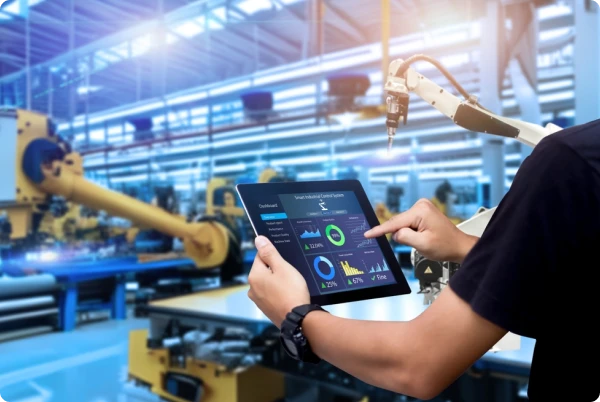
Factories are evolving from isolated production units into intelligent, connected ecosystems powered by Industry 4.0. Real-time data, automation, and system interoperability are driving smarter decision-making and agile operations. Yet, this transformation hinges on seamless integration between machines, people, and enterprise systems. At Lighthouse, we enable this connection through ERP-MES integration, turning complex manufacturing environments into data-intelligent operations with full visibility, traceability, and control.
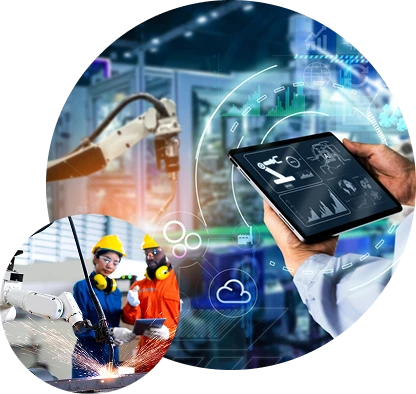
A manufacturing execution system is a tool that helps industrial organizations to monitor in real time all the manufacturing operations that take place in their production centers, from the entry of raw materials, through the planning and execution of production orders coming from the ERP to the shipment of the final product
The main functionality of MES is to provide factory managers and workers with the necessary information so that they can, among other things: detect efficiency losses and problems; correct deviations on the shop floor before it is too late; digitize maintenance management; ensure traceability and compliance with quality and safety standards, eliminate the use of paper documents; and develop and implementation continuous improvement plans.
The growing need for industrial companies to adapt quickly to demand and become more profitable and sustainable has led more companies to decide to implement an MES system. Thanks to this software and its ability to automate data capture in the plant, organizations can exercise reliable, real-time control of their daily operations.
In a smart factory, business decisions and shop-floor operations must work in harmony. ERP software for manufacturing industry handle business level processes such as planning, inventory management, costing, and procurement, ensuring that production strategies align with overall organizational goals. On the other hand, MES controls the execution layer, monitoring real-time production activities, machine performance, and workforce tasks on the shop floor.
By integrating ERP with MES, manufacturing bridge the gap between planning and execution. This connection allows production schedules to adapt dynamically, inventory to be tracked accurately, and costs to be mentioned in real-time. The result is a fully connected ecosystem where decisions at the business level immediately reflect on the shop floor, enabling smarter, faster, and more efficient operations.
Integrating ERP and MES creates a single, connected environment where all production, inventory, and business data is centralized. This ecosystem ensures that information flows seamlessly from the production machine on the shop floor with ERP systems, organizations eliminate data silos and ensure that everyone works from the same accurate information, enabling better decision-making based on comprehensive, real-time data.
Managers and operators can see the status of production, inventory, and machine performance in real time, without waiting for manual reports. This visibility provides immediate insights into production progress, enables quick responses to bottlenecks or deviations, and enhances coordination between operations and corporate planning. Data from sensors and machines flows into MES and then ERP dashboards, giving a complete view of the production from the shop floor to the top floor.
With integrated ERP and MES, companies can help production more accurately based on real-time capacity, material availability, and customer demand. This optimization reduces idle time, prevents overstock or stockouts, and aligns production schedules with business objectives and customer requirements, ensuring operations run efficiently.
Integration allows issues on the shopfloor, such as machine failure or quality deviations, to be detected immediately. This reduces unplanned downtime, enables technicians to act quickly, and improves overall equipment effectiveness. Machines report alerts to MES, which communicates with ERP workflows to trigger rapid corrective actions, minimizing production losses.
ERP and MES integration ensures that production data, quality checks, and regulatory records are automatically captured. This supports consistent product quality, simplifies audits, and guarantees full traceability from raw materials to finished products. MES logs machine performance and operator inputs, and ERP consolidates this information for compliance reporting and risk reduction.
Industry 4.0 thrives on smart, connected factories where machines, people, and systems communicate seamlessly.
This requires reliable ways to link ERP, MES, and other business or production systems. Common methods include:
Trigger-driven calls for information from an MES system via REST API interface.
Custom SQL connections should be developed using Microsoft Open Database Connectivity (ODBC), Java Database Connectivity (JDBC), or any other interface.
A point-to-point connection for information transfer via FTP. The ERP system needs to provide the requested data.
ERP integration helps solar manufacturers manage project planning, track equipment and materials, monitor production schedules, and ensure timely delivery, improving efficiency and reducing project delays.
Manufacturers can track every stage of production and monitor quality in real-time, ensuring that components meet strict standards and reducing the risk of defects.
Integration enables better equipment utilization by analyzing performance and downtime, helping factories optimize operations and improve overall productivity.
Companies can maintain regulatory compliance more efficiently, track every batch of production, and ensure product safety, making audits and reporting much easier.
Lighthouse brings deep expertise in ERP and MES systems specifically tailored for manufacturing, ensuring that business processes and shop-floor operations work seamlessly together. Our proven Industry 4.0 frameworks guide manufacturers through every stage of digital transformation, providing structured, reliable pathways to smarter factories.
We offer single point comprehensive analytics solutions. These are built on top of integration platforms bringing data from various sources like ERP, MES and device APIs & automation, so that every system and device can communicate effectively. Our solutions are designed with scalability, flexibility, and future readiness in mind, allowing your operations to evolve with emerging technologies and changing business needs.
Take a next step: Let's build your connected factory