hrm

Supply Chain Management

Supply Chain Management erp software is a digital platform that manages and connects every stage of the supply chain from sourcing raw materials to delivering finished goods. The processes, such as procurement, inventory, warehousing, logistics and vendor coordination, are tracked and managed all in one system

Lighthouse ERP’s SCM module is designed specifically for manufacturing businesses where a small mistake can affect production and profitability. The supply chain module brings the entire chain onto a single, streamlined platform, helping manufacturers improve visibility, reduce delays, and keep operations running smoothly.
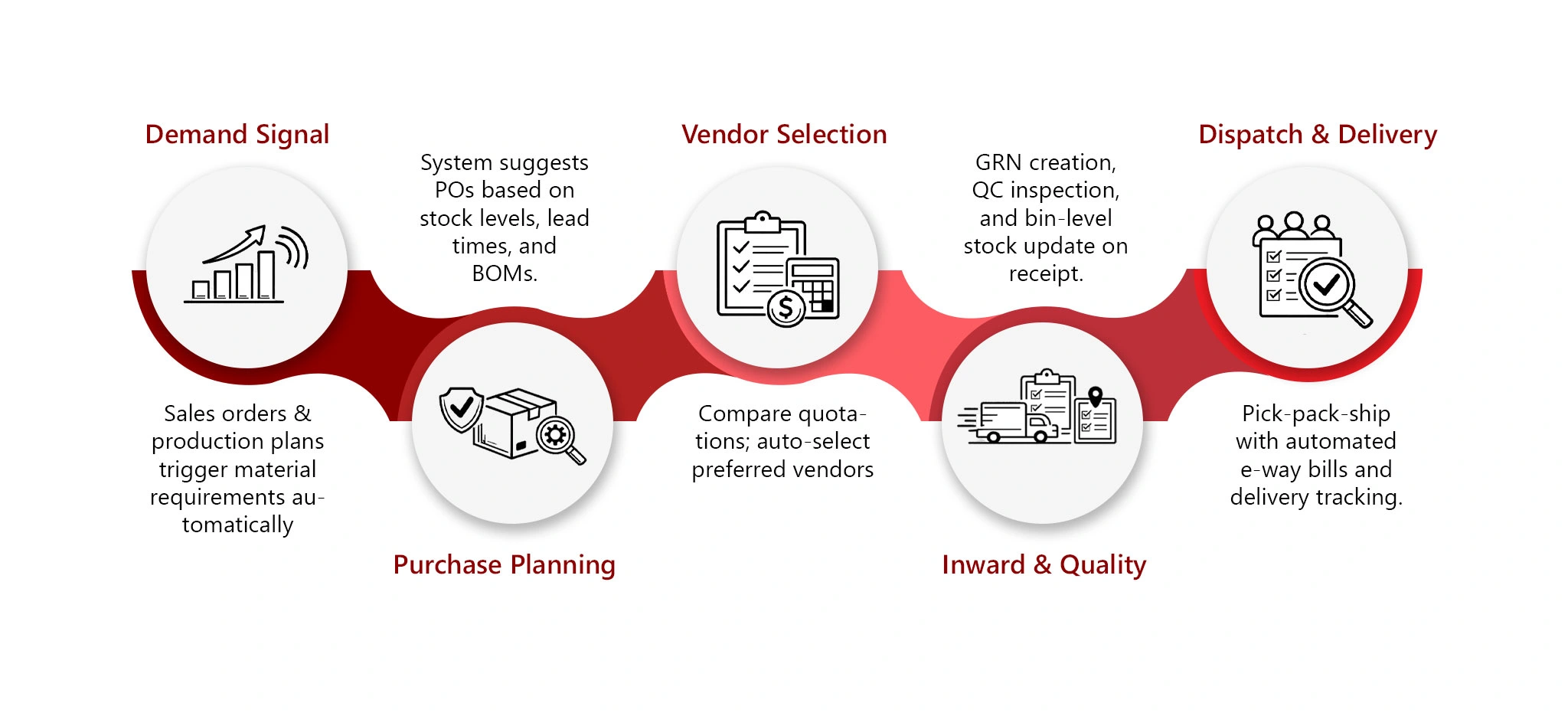

THE SCM FLOW

How Supply Chain Management Works in Lighthouse ERP

A single, connected flow - from demand signal to delivery confirmation.

process flow

Special Features

Procurement Automation

Auto-generate purchase orders based on reorder levels and demand forecasts, eliminating manual follow-up. 

Inventory Visibility

Track stock across multiple godowns and locations in real time with zero manual reconciliation. 

Vendor Performance

Score suppliers on delivery timelines, quality rejection rates, and pricing consistency.

Logistics & Dispatch

Plan outbound shipments, generate e-way bills, and track deliveries from a unified dashboard.

Demand Planning

Use historical data and sales pipeline signals to forecast material requirements before shortages occur.

ERP Integration

Fully connected with Finance, Production, Sales, and HR modules — one source of truth for your entire business

Streamline your entire buying cycle with automated workflows and approval controls. 

  • Purchase indent & RFQ generation
  • Vendor quotation comparison
  • PO approval workflows
  • AMC and rate contract management
  • 3-way PO–GRN invoice matching

Maintain optimal stock levels across all locations with real-time tracking.

  • Multi-location stock management 
  • Batch, lot, and serial number tracking 
  • Reorder level alerts and auto replenishment 
  • Stock ageing and dead-stock reports 
  • Physical inventory reconciliation 

Never stop a production line due to a material shortage again. 

  • BOM-based material planning
  • Demand-driven purchase suggestions 
  • Lead time-aware procurement scheduling 
  • Safety stock and buffer management 
  • What-if scenario planning 

Build a reliable supplier base with data-driven performance tracking. 

  • Vendor registration and approval 
  • Delivery performance scorecards 
  • Quality rejection rate tracking 
  • Vendor payment scheduling 
  • Preferred vendor categorisation 

Ship on time, every time, with streamlined outbound operations. 

  • E-way bill and GST invoice generation 
  • Transporter management 
  • Delivery tracking and POD capture 
  • Freight cost allocation 

Make faster decisions with real-time visibility across your entire chain.

  • Procurement spend analysis
  • Inventory turnover and fill rate KPIs
  • Vendor on-time delivery reports
  • Demand vs. supply gap analysis
  • Mobile accessible dashboards

What Manufacturers Gain with Lighthouse SCM (BENEFITS)

Reduced Inventory Carrying Costs Demand-driven replenishment stops over-purchasing. Clients report up to 15% reduction in dead stock within the first year. 

Faster Production Cycles Material shortages don't stop lines. MRP-based procurement ensures raw materials arrive before they're needed.  

Better Vendor Relationships Data-backed negotiations. Know which vendors deliver on time and which inflate lead times — and act accordingly.

GST & Compliance Ready Automatic e-way bill generation, GST-compliant purchase records, and audit-ready transaction logs built in.

Fewer Manual Errors Integrated PO–GRN–invoice matching eliminates duplicate payments and short-supply disputes automatically.

Frequently Asked Questions About ERP Software for Supply Chain Management

SCM software within an ERP is a module — or set of connected modules — that manages every stage of the supply chain from demand signal to delivery confirmation: procurement automation, inventory tracking across locations, material requirements planning, vendor performance management, logistics and dispatch, and supply chain analytics. The key distinction from standalone SCM tools is that it shares one data layer with finance, production, sales, and HR — so a change in one area is immediately visible in all others.

MRP uses the Bill of Materials for production orders, current stock levels, open purchase orders, and sales pipeline data to forecast exactly what materials will be needed and when. Purchase suggestions are generated with lead times factored in, so procurement orders are placed early enough for materials to arrive before a production line needs them. Clients report that BOM-based MRP is one of the highest-impact modules for reducing unplanned production stops.

Three-way matching compares the original Purchase Order (what was ordered and at what price), the Goods Receipt Note (what was actually received), and the supplier's invoice (what is being billed). All three must align within defined tolerances before payment is approved. This automated matching eliminates duplicate payments, short-supply disputes, and the manual cross-checking that accounts payable teams otherwise do for every purchase transaction.

Suppliers are evaluated on delivery timeline adherence, quality rejection rates, and pricing consistency against contracted rates. These performance scores build over time and are available before any new negotiation or purchase decision. For a manufacturing business with multiple approved vendors for the same material, the ability to see actual performance data rather than relying on the vendor's own delivery estimates is a meaningful procurement advantage.

Historical sales data and current sales pipeline signals are combined to forecast material requirements before shortages occur. Demand-driven replenishment means purchase orders are sized to what is actually expected to be consumed rather than to a fixed periodic quantity — which is what leads to dead stock building up in the first place. Clients report up to 15% reduction in dead stock within the first year of using demand-driven replenishment.

Stock is tracked in real time across every godown or warehouse location with batch, lot, and serial number granularity. Reorder alerts are set at the location level, not just at the overall company level, so a shortage at one site doesn't go unnoticed simply because aggregate stock looks adequate. Stock ageing reports identify slow-moving inventory before it crosses the threshold into dead stock.

E-way bills are generated automatically at the point of dispatch, GST-compliant purchase records are maintained for every GRN, and audit-ready transaction logs are available for every step in the supply chain — from purchase indent to final delivery POD. This built-in compliance removes the need for a separate compliance workflow running alongside operations and reduces the risk of gaps between operational records and tax filings.