Top ERP Software for Manufacturing in India — The Honest Guide
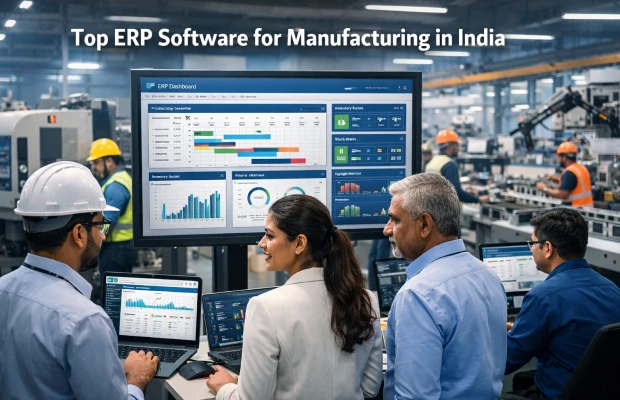
Let's be honest — running a manufacturing business in India is no walk in the park. You've got production targets to hit, raw material costs to manage, GST filings that won't wait, and a team that needs to know exactly what's happening on the shop floor at any given moment. That's a lot to juggle, and doing it on outdated systems — or worse, Excel sheets — just doesn't cut it anymore.
That's where ERP software comes in. Think of it as the central nervous system of your entire operation. When the right ERP is in place, your purchase team, production managers, accounts department, and sales folks are all working from the same real-time data. No more "which version of the file is correct?" chaos.
India's manufacturing sector is growing fast — and so is the ERP market. But with dozens of options available, which one is actually right for a manufacturer like you? We've done the legwork. In this blog, we compare the top 6 ERP solutions built for Indian manufacturing — including one that's been quietly powering factories across India for over four decades.
Top ERP Software for Indian Manufacturers
Here's our curated list of the best manufacturing ERP solutions currently available in India — what they do, who they're for, and what makes each one tick.- SAP S/4HANA
- Lighthouse ERP
- Oracle NetSuite
- Microsoft Dynamics 365
- Sage X3
- Oracle Fusion Cloud ERP
- Infor CloudSuite (Industrial ERP)
SAP S/4HANA
SAP is the global giant of ERP, and for large manufacturers running complex, multi-plant operations, SAP S/4HANA is the gold standard. It runs on an in-memory database that processes massive volumes of data in real time — meaning your reports aren't showing you yesterday's numbers, they're showing you right now.
SAP's strength lies in its depth. You can manage intricate global supply chains, run sophisticated production planning (MRP), handle multi-currency financials, and integrate with hundreds of third-party tools. However, that depth comes with complexity — and a price tag that can be a serious barrier for mid-size Indian manufacturers. Implementation can take 12–24 months and often requires specialized SAP consultants.
In-Memory Real-Time Analytics
Advanced Production Planning (MRP)
Global Supply Chain Management
AI-Driven Automation
Multi-Currency & Multi-Plant
Predictive Maintenance
Procurement & SRM
Financial Consolidation
Cloud Deployment (RISE with SAP)
Extensive Third-Party Integration
Lighthouse ERP
If you want an ERP that truly understands Indian manufacturing — not just theoretically, but from decades of actually working with Indian factories — Lighthouse ERP deserves to be at the top of your list. Built by Lighthouse Info Systems and available at www.lighthouseindia.com, this system has been evolving since 1987 and has grown with Indian industry every step of the way.
What sets Lighthouse apart is how deeply industry-specific it is. Whether you're making steel, transformers, electrical equipment, cables, or running a process plant — Lighthouse has purpose-built modules designed around your exact workflows, not a generic template that sort of fits. They've also embraced Industry 4.0, offering ERP-MES integration that connects your shop floor machines directly to your enterprise planning system. That means real-time visibility from the production machine all the way up to the boardroom dashboard.
With 1,000+ clients across 35 industries and a 95%+ client retention rate, the numbers speak for themselves. And if you're worried about being left hanging after implementation — their 24/7 support has you covered.
Production Planning & Scheduling
Shop Floor MES Integration
Multi-Level BOM Management
GST & Indian Compliance
Real-Time Inventory Control
Quality Management (QC/QA)
CRM & Sales Order Management
HRM & Payroll
Business Intelligence Dashboards
ETO / MTO / MTS Support
Industry 4.0 / IoT Ready
Cloud & On-Premise Options
Oracle NetSuite
Oracle NetSuite is a fully cloud-native ERP that's particularly popular with fast-growing mid-market manufacturers who want enterprise-level capabilities without the on-premise infrastructure headaches. It's a strong choice for manufacturers who do significant e-commerce or D2C sales alongside traditional B2B, since it integrates those channels natively.
NetSuite's warehouse and supply chain modules are well-regarded, and its financial reporting is genuinely excellent. The downside for Indian manufacturers? It can feel a bit generic when it comes to local compliance nuances like GST e-invoicing, and customizations can get expensive. It's also predominantly priced in USD, which adds cost unpredictability.
Cloud-Native Architecture
Demand Forecasting & Planning
Financial Management
CRM Integration
E-Commerce Integration
Advanced Analytics
Multi-Subsidiary Management
Work Order & Assembly
Real-Time Dashboards
Warehouse Management
Microsoft Dynamics 365
If your team already lives in Microsoft Office, Teams, and Power BI, Dynamics 365 will feel remarkably natural. It's a modular ERP that allows manufacturers to start with what they need — Finance, Supply Chain, or Manufacturing — and add more over time. The AI-powered Copilot features are genuinely impressive, helping predict demand, flag supply chain risks, and automate routine workflows.
Dynamics 365 also scales well, making it suitable for both mid-market manufacturers and large enterprises. The main challenge is that you often need a certified Microsoft Partner for implementation, and costs can balloon quickly once you start customizing. Still, its Power BI integration is best-in-class for manufacturers who are serious about data-driven decisions.
AI Copilot & Predictive Analytics
Supply Chain Optimization
Production Floor Management
Power BI Integration
Asset Management
Lean Manufacturing Support
IoT Sensor Integration
Teams & Office 365 Integration
GST Compliance (with partner)
Cloud & Hybrid Deployment
Sage X3
Sage X3 is a solid mid-market ERP that punches well above its weight in process manufacturing — think chemicals, food & beverage, and pharma. It offers enterprise-grade capabilities at a price point that's more accessible than SAP or Oracle, and it handles multi-site and multi-language operations gracefully — useful for manufacturers with pan-India operations or export ambitions.
Sage has a growing presence in India, and its X3 platform includes modules for production management, quality control, procurement, and advanced financial reporting. The platform also integrates with IoT and ML technologies, which matters as Indian factories move toward Industry 4.0. It can feel less customizable than some Indian-built alternatives, but it's a dependable, well-supported option for mid-sized manufacturers.
Process Manufacturing Focus
Multi-Site & Multi-Language
Advanced Financial Reporting
Quality Control & Traceability
Procurement Management
IoT & ML Integration
Supply Chain Management
Product Lifecycle Management
Field Service Management
Cloud & On-Premise Options
Oracle Fusion Cloud ERP
Powered by Oracle Corporation, Oracle Fusion Cloud ERP is built for companies that want a modern system without the baggage of legacy software.
Since it’s designed completely for the cloud, everything feels more seamless—your data is always up to date, updates happen automatically, and you don’t need to worry about managing heavy IT infrastructure. It’s especially strong when it comes to finance and decision-making, giving you real-time visibility into cash flow, costs, and overall business performance.
What really makes Oracle stand out is how it uses AI in the background. From automating invoices to helping with forecasting, it quietly takes care of repetitive work so your team can focus on bigger decisions.
That said, it’s still an enterprise-level ERP. You’ll need proper planning and alignment to get the most out of it. But compared to traditional systems, it’s more flexible and easier to adapt—making it a strong option for growing businesses that want structure without unnecessary complexity.
Cloud-Native Architecture
Real-Time Financial Insights & Reporting
AI & Machine Learning-Driven Automation
Global Procurement & Supplier Management
Project & Cost Management
Multi-Entity & Multi-Currency Support
Embedded Analytics & Dashboards
Risk Management & Compliance Controls
Continuous Updates (Quarterly Releases)
Strong Integration with Oracle Ecosystem
Infor CloudSuite (Industrial ERP)
Built by Infor, Infor CloudSuite takes a different approach—and that’s exactly why many manufacturers prefer it.
Instead of being a one-size-fits-all ERP, it’s designed specifically for industries like manufacturing. That means a lot of what you need is already built in, so you’re not spending months customizing the system just to match your processes.
It works especially well on the shop floor level—from planning and scheduling to tracking production in real time. The system feels more practical and closer to how factories actually operate, which makes it easier for teams to adopt.
Because of this focused approach, implementation is usually faster and smoother. While it may not have the global scale of SAP or the deep financial capabilities of Oracle, it delivers where it matters most—getting operations under control without overcomplicating things.
Industry-Specific ERP for Manufacturing
Advanced Planning & Scheduling (APS)
Strong Shop Floor & Production Control
Supply Chain & Warehouse Management
Embedded Analytics (Infor Birst)
Cloud Deployment (AWS-Based Infrastructure)
Quality Management & Compliance Tracking
User-Friendly, Role-Based Interface
Faster Implementation Timeline
Lower Total Cost of Ownership
Why Lighthouse ERP Stands Out for Indian Manufacturers
When we talk about an ERP that was built ground-up for Indian manufacturing — not adapted, not localized, but genuinely built for this environment — Lighthouse ERP at www.lighthouseindia.com is the name that keeps coming up.
40+ Years of ERP Experience
1000+ Global Clients Served
35+ Industries Supported
95%+ Long-Term Client Retention
24/7 Expert Support
Deep Manufacturing DNA
Lighthouse was born in manufacturing. Its modules aren't generic — they're built around how Indian factories actually work, from shop floor to dispatch.
Industry 4.0 & MES Integration
Real-time connection between your machines, shop floor, and enterprise planning. Sensor data flows directly into ERP dashboards for live OEE monitoring.
Industry-Specific Solutions
Dedicated ERP builds for steel, transformers, electrical equipment, cables, piping, biofuels, and more — not a one-size-fits-all approach.
Business Intelligence Built In
Real-time MIS reports, dashboards, and analytics that give plant managers and owners the clarity to make faster, smarter decisions.
Full Indian Compliance
GST, e-invoicing, statutory reports — all baked in. No hacks, no workarounds. Lighthouse understands Indian regulatory requirements deeply.
Modular & Scalable
Start with what you need — production, inventory, finance — and add more as you grow. You're never locked into paying for modules you don't use.
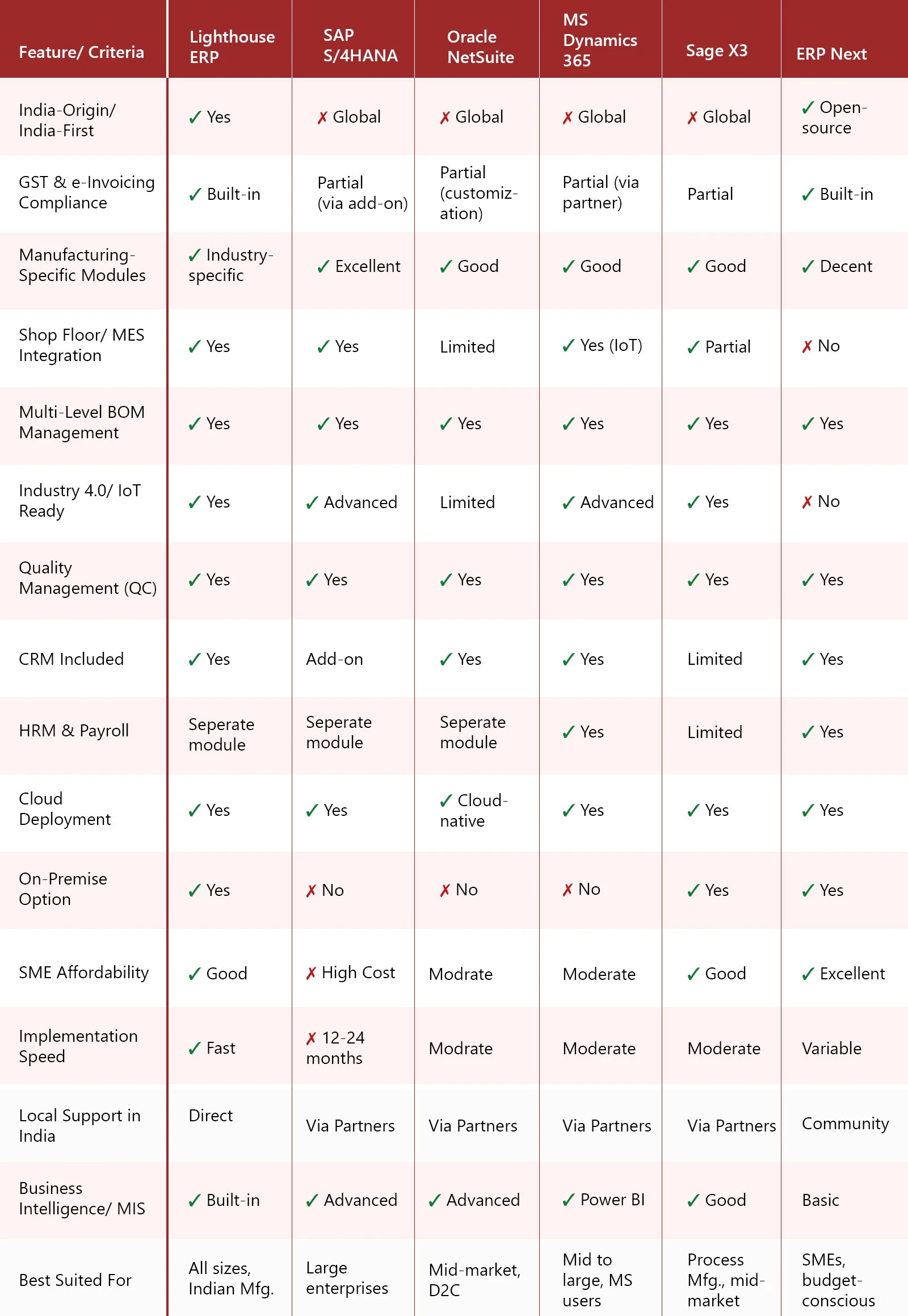
ERP Comparison Table for Indian Manufacturers
Why Indian Manufacturers Can't Afford to Wait
The numbers are pretty clear — manufacturers who adopt the right ERP see measurable gains. Here's what's at stake if you put this decision off.
Inventory Losses Are Killing Margins
Without real-time visibility, most manufacturers lose 10–18% of potential revenue to scrap, overstock, and stockouts. An ERP plugs that leak.
GST & e-Invoicing Compliance Is Non-Negotiable
The GST framework keeps evolving. Manual compliance is a liability. A good ERP keeps you automatically compliant without the last-minute scramble.
Your Competitors Are Already Digital
62% of mid-to-large Indian manufacturers are still on legacy systems. That gap is shrinking fast — the early adopters are pulling ahead.
PLI Schemes Reward Efficiency
India's Production Linked Incentive schemes favor manufacturers who can demonstrate operational efficiency and output. ERP data makes that case for you.
Customer Expectations Are Rising
Your customers want delivery updates, quality certificates, and traceability data on demand. Without an integrated ERP, that's nearly impossible to provide at scale.
Scale Requires Systems, Not Spreadsheets
You can grow to a point on Excel. But beyond that point, the lack of systems becomes the ceiling. ERP removes that ceiling.
The Right ERP Is Out There — Start Here
Every factory is different. A pharma batch manufacturer has different needs from a steel plant or an auto-component maker. The best ERP for your business is the one that fits your workflows, speaks your compliance language, and grows with you — not the one with the biggest global marketing budget.
That's why for Indian manufacturers, Lighthouse ERP stands out as the most natural starting point. Four decades of manufacturing experience, 1,000+ clients, and industry-specific solutions that don't need to be retrofitted to fit your floor — that's a foundation worth exploring.