Building a Platform to Make Your Aluminium Extrusion Unit Truly BIS Ready
There's a conversation that plays out far too often in aluminium manufacturing plants across India. A BIS audit is three weeks away. The quality team scrambles to pull test certificates. The production floor searches for heat number records. Someone is printing out spreadsheets to prove that the raw material used for a particular dispatch was tested and approved. The auditors arrive, and despite the genuine compliance work the unit has done, the evidence trail is fragmented. It shouldn't be this hard.
The problem, almost invariably, isn't that these manufacturers aren't doing the right things. They are testing their material, maintaining process parameters, issuing test certificates. The problem is that all of this lives in silos — a QC register here, a production log there, an invoice system that has no idea what a heat number is.
If you are building or upgrading an ERP platform specifically to support BIS certification under the Aluminium Quality Control Order, you need to approach it differently. BIS compliance is not a module you bolt on to an existing system. It is a data philosophy — one where every kilogram of aluminium leaving your plant carries a verifiable, digitally-documented lineage from the raw material it came from to the test results it passed.
Let's walk through how that looks in practice, and why three specific ERP modules — Quality Control, Production, and Inventory — have to work as a single cohesive system rather than separate tools.
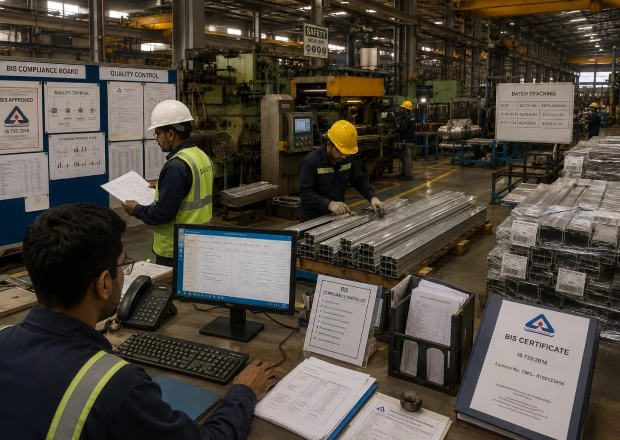
Quality Control — The Audit's First Question
Every BIS audit for an aluminium extrusion unit begins and ends with the same question: can you prove, for any product you dispatched, that it was tested, that it passed, and that the test was conducted correctly? The QC module in your ERP is the system that must answer that question without hesitation.
The foundation here is raw material testing. When a consignment of aluminium alloy ingots or billets arrives, the system should not allow it to enter usable stock until a chemical composition test is recorded and approved. This means capturing the vendor's Certificate of Analysis, comparing it against the IS standard composition for that specific alloy grade, and placing the material on automatic QC hold until the verification is complete. In practice, most plants still do this on paper — which means the data exists but isn't searchable, isn't linked to downstream production, and certainly isn't available to an auditor at a moment's notice.
What the QC Module Must Be Built to Do
- Raw Material Validation
Chemical composition checks alloy-wise against IS standards, with vendor COA capture and auto-hold until QC sign-off is recorded.
- In-Process Stage Inspection
- Final Dispatch Clearance
- Test Certificate Generation & Linkage
- Lab Equipment Integration
Inspection checkpoints mapped to each manufacturing stage — melting, casting, extrusion, finishing — with real-time rejection logging.
Mechanical properties and dimensional tolerance checks before finished goods are released; no clearance, no dispatch.
TCs generated from the system and tied directly to batch/heat numbers and customer dispatch records — not created separately in Word.
Direct data capture from spectrometers and UTM machines, eliminating manual transcription and the human errors that come with it.
That last point — lab integration — is worth pausing on. When a spectrometer reading has to be manually typed into a register, you have introduced a point of failure that an auditor will flag immediately. Not because they distrust your team, but because any manual data entry step is, by definition, a control gap. Direct machine integration removes that gap entirely.
Beyond traceability, the production module must enforce the alloy recipe. For each grade you manufacture — whether it's 6063, 6061, or any other alloy — there should be a defined Bill of Materials specifying the composition ranges mandated by the relevant IS standard. The system should validate actual input ratios against that BOM and flag deviations before they become a quality problem rather than after.
Production Module Capabilities BIS Compliance Demands
- Heat Number Generation & Material Genealogy
- Alloy Recipe / BOM Control
- Process Parameter Recording
- Routing & Stage Status Tracking
- Rework & Scrap Segregation
Unique heat IDs auto-generated at melting stage, with end-to-end traceability from input raw material to finished goods.
Defined composition BOMs for each grade, with real-time validation against IS standards before and during production.
Temperature logs for melting and casting, machine settings for extrusion pressure and rolling speed — captured systematically, not on whiteboards.
Defined production routing with status visibility at every stage so nothing 'disappears' between departments.
Rejected material formally quarantined in the system — it cannot re-enter production flow without a rework authorisation cycle.
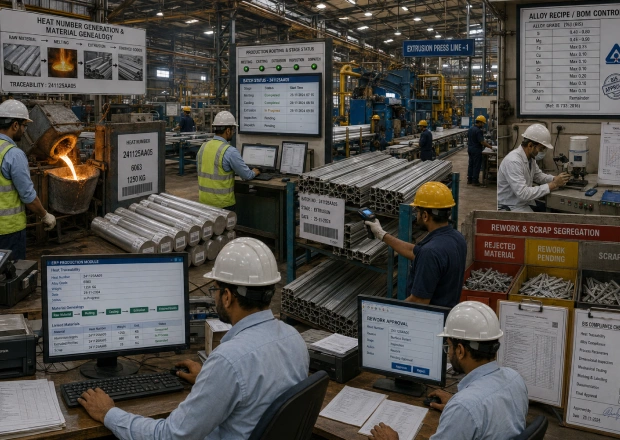
The process parameter recording piece is often underestimated. Extrusion temperature, die temperature, cooling rate — these aren't just operational settings. They are the evidence that your process is being run as designed. When an auditor asks 'how do you know this extrusion was produced under controlled conditions?', these logs are the answer.
Inventory — The Gatekeeper Between Production and the Customer
A common failure point in BIS-aligned manufacturing is this: the QC work gets done, the test certificates get issued, but at the dispatch stage, there is no systematic link between the product going out the door and the documentation that proves it's compliant. A customer receives a consignment, a BIS inspector conducts market surveillance, and the manufacturer cannot definitively say 'this specific section came from heat number X, which passed test Y on date Z.' That is a compliance failure — even if the testing was actually done.
The inventory module closes this gap. It is the control layer that ensures only tested, approved material reaches dispatch — and that every dispatch is traceable back through the chain.
- Mandatory Batch/Heat Tagging
- Location-wise Material Movement Tracking
- Dispatch Gatekeeping
- Test Certificate Linkage at Invoicing
Raw material, WIP, and finished goods all carry batch or heat identifiers — no untagged stock can exist within the system.
Every transfer — from stores to production to QC to finished goods to dispatch — is logged, so the material's journey is always visible.
System-enforced rule: only QC-approved stock can be allocated to a sales order; any attempt to dispatch unapproved material is blocked at the system level.
Invoice generation requires a linked TC — no TC, no invoice. The documentation and the commercial transaction are inseparable.
This last point — TC linkage at invoicing — is more significant than it might appear. It creates an audit trail that is automatic and unbypassable. No one in accounts can generate a dispatch invoice for a product that hasn't been through QC. No product can leave the plant without its compliance documentation attached. For a BIS audit, or for a product recall scenario, this is what allows a manufacturer to respond quickly and accurately.
Compliance as Operational Maturity
There is a tendency, even among well-run manufacturing businesses, to treat BIS certification as a regulatory hurdle — something to prepare for, pass, and then manage carefully until the next renewal. That framing is understandable, but it leads to exactly the kind of fragmented, audit-mode compliance that creates stress and risk.
The alternative view — and the one that the best aluminium manufacturers in the country are moving toward — is that a BIS-ready ERP platform isn't primarily about satisfying the Bureau. It's about building a manufacturing operation where quality is documented as a byproduct of doing the work correctly. The test certificates, the heat records, the dispatch linkages: these should exist because your process produces them naturally, not because an auditor is coming.
When the three modules — QC, Production, and Inventory — are built with data continuity as the design principle, compliance becomes a state your organisation is always in, not one you scramble to achieve. The audit becomes a review rather than a rescue operation. And perhaps more importantly, the data you've accumulated becomes genuinely useful: for improving yield, for understanding rejection patterns, for benchmarking process performance across shifts or lines.
If you're at the point of building or upgrading your ERP with BIS in mind, the most valuable question to ask about any proposed feature is this: does this create traceability, or does it break it? Every system design decision, every workflow, every approval step should be evaluated against that standard. Because when the auditor walks in, the only thing that matters is whether you can trace every product back to every test, every test back to every heat, and every heat back to every raw material — in seconds, not hours.