Think You’re BIS Ready?
Why Most Aluminium Manufacturers Are Not
There is a moment every aluminium manufacturer will face in 2025 and 2026 — a BIS surveillance auditor walks in, clipboards in hand, and asks to see your quality records. How prepared you are for that moment will determine whether your business continues to operate or not.
This is not an exaggeration. The latest Quality Control Order (QCO) for aluminium has drawn a hard line in the sand. Compliance has moved from a box you could tick at your convenience to a legal prerequisite for market access. And yet, despite the weight of this change, the majority of aluminium manufacturers in India are still operating with gaps that would fail a BIS audit.
This article walks through what has changed, what BIS expects of you on an ongoing basis, and the five most common operational gaps that are putting manufacturers at risk right now.

What the Aluminium QCO 2025/2026 Actually Changes
Let us be direct about what this order does. The Aluminium Quality Control Order does not merely tighten existing rules — it reframes the entire compliance landscape. Previously, BIS certification for many aluminium products was voluntary. A manufacturer could choose to pursue the ISI mark as a quality signal to buyers. That era is over.
Under the QCO 2026, specified aluminium products must carry BIS certification before they can be sold or imported into India. The certification is issued under Scheme-I, commonly known as ISI Mark Licensing. This is not a lighter-touch scheme. It requires manufacturers to demonstrate that their production processes, raw material controls, and quality systems consistently meet the relevant Indian Standards.
The practical consequence is straightforward: no ISI mark means no sale. For importers, the impact is equally severe — customs clearance for non-BIS certified aluminium products is blocked at the border. There is no workaround, no grace period for established suppliers, and no exemption for small volumes.
The Non-Negotiable Reality
- No ISI Mark = Cannot sell specified aluminium products in India
- Imports of non-certified products are blocked at customs
- Selling, distributing, or stocking non-BIS products is a legal violation
BIS Certification Is Not a Milestone — It Is an Ongoing Commitment
One of the most dangerous misconceptions in the industry is treating BIS certification as a one-time achievement. Many manufacturers invest effort in getting the licence, celebrate when the ISI mark arrives, and then quietly let their processes drift. BIS has built its surveillance system precisely to catch this drift.
Once licensed, your facility becomes subject to a continuous oversight regime. This operates on two levels:
- Periodic factory audits: BIS officers conduct periodic surveillance audits at your factory. These visits assess whether your current production processes, raw material sourcing, in-process testing, and documentation practices match what was approved at the time of licensing. Any deviation from the approved process is treated as a compliance failure, regardless of whether the end product happens to pass a test.
- Market sample testing: BIS also pulls samples from the open market — from distributors, stockists, and retail channels — and sends them for independent laboratory testing. If a product bearing your ISI mark fails these tests, the consequences are serious: suspension or cancellation of your licence, recall requirements, and potential legal action.
What this means in practice is that consistent quality is not just a customer expectation. It is a legal obligation. A batch that deviates from your approved formulation, even if it physically resembles conforming product, is a non-compliance event waiting to be discovered.
What Continuous Compliance Requires
- Consistent adherence to approved production processes — every batch, every shift
- Quality systems that produce verifiable, auditable records
- No deviation from approved raw material sources or alloy compositions
- Documented traceability from input material through to finished goods dispatch
The Five Gaps Putting Manufacturers at Risk
Across aluminium manufacturing facilities, the same patterns of non-compliance appear repeatedly. These are not exotic or technical failures. They are common operational habits that made sense when quality management was an internal matter but which are now direct liabilities under BIS enforcement.
1. Quality Control Managed in Excel, Disconnected from Operations
Many manufacturers maintain their quality control records in spreadsheets that exist entirely outside their production or ERP systems. The QC team logs test results, the production team logs output, and the two never speak to each other. During a BIS audit, inspectors will ask to trace a specific batch from its raw material intake through testing to finished goods. If your QC records sit in a separate Excel file with no linkage to production orders or batch numbers, you cannot provide that trace. That is an audit failure, and it is entirely preventable.
2. Batch Traceability That Stops at the Finished Goods Stage
Some manufacturers do maintain batch records for finished goods — they can tell you which pallet left on which date. But when asked to show what raw materials went into that batch, from which supplier, with what incoming inspection results, the trail goes cold. BIS traceability requirements cover the entire production chain. Finished goods tagging alone is insufficient. If scrap was introduced, it needs to be traceable. If an alloy addition was made, the composition documentation must be available. The audit question is never just “what did you produce?” but “how do you know it meets the standard?”
3. Manual Test Certificates Without System Linkage
Handwritten or manually typed test certificates are a significant audit risk. Not because auditors object to paper, but because a manual certificate cannot prove that the test actually happened, that the right sample was tested, and that the result genuinely corresponds to the batch in question. When test certificates are generated by an instrument or LIMS system and linked to a specific production batch by ID, the chain of evidence is intact. When a technician fills in a form by hand, that chain is broken. Under a rigorous surveillance audit, this gap can be treated as an absence of quality records.
4. Scrap Reuse Without Composition Verification
Aluminium scrap reuse is economically important and entirely legitimate under BIS standards — provided it is done with appropriate controls. What is not acceptable is introducing scrap into the melt without first verifying its composition. Scrap from different alloy grades, mixed with virgin material, can push the final alloy outside its specification range. If that batch carries your ISI mark, and a market sample pulls that product and tests it, you have a non-conformance against the standard to which you are licensed. Composition verification before scrap introduction, documented with spectroscopic analysis, is the minimum requirement here.
5. Goods Dispatched Without Confirmed QC Clearance
Perhaps the most commercially dangerous gap is the absence of a hard gate at dispatch. In many facilities, the dispatch team and the quality team operate independently. Production pressure or customer urgency can result in goods leaving the factory before QC has formally cleared the batch. Once those products reach the market with your ISI mark on them, they are your legal responsibility. If they fail a sample test, the fact that QC “was going to clear them” offers no protection. Dispatch should only happen after a system-confirmed QC release — not as a policy aspiration, but as a process control that cannot be bypassed.
What a Genuinely BIS-Ready Operation Looks Like
Getting to genuine BIS readiness is less about adding paperwork and more about integrating quality into the operational fabric of the business. The manufacturers who consistently pass BIS surveillance audits share certain characteristics:
- Their QC and ERP systems are connected. A production order generates a batch record. That batch record is linked to the QC plan, the actual test results, and the dispatch record. The data flows automatically; it is not manually assembled before an audit.
- Traceability is end-to-end. From the incoming inspection record of the raw material to the dispatch note for the finished goods, every step is documented and linked by a common batch or lot identifier.
- Test results are instrument-generated and system-stored. Whether it’s a spectroscopic analysis or a mechanical properties test, the result goes directly from the instrument into the record. Human transcription is minimised and auditable where it exists.
- Scrap is a controlled input. Every introduction of scrap into the production process is preceded by composition verification and documented with a spectro result. The scrap source, grade, and test result are part of the batch record.
- Dispatch is gated by QC. No goods leave without a system-confirmed release status. The dispatch team does not have the authority to override QC hold without a documented exception process.
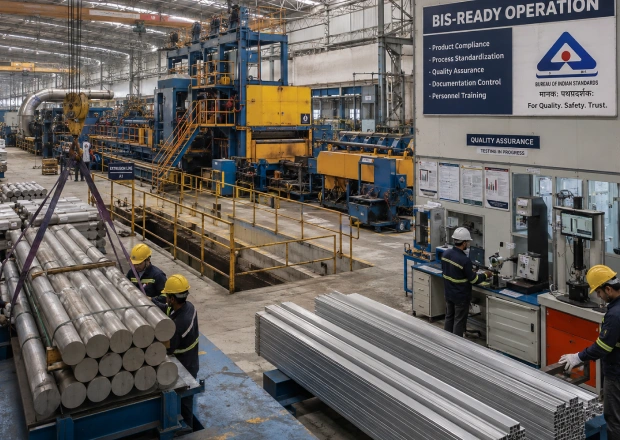
None of this requires expensive technology. It requires clear process design, system integration where it matters, and a culture where quality is treated as a production input rather than an afterthought.
The Question Is Not Whether You Will Be Audited
Under the Aluminium QCO 2025/2026, BIS surveillance is not a theoretical risk. It is a scheduled certainty, supplemented by unannounced market sampling. The question every manufacturer should be asking is not whether an auditor will arrive, but whether the operation they run today could withstand that visit.
The five gaps described in this article are not found in struggling operations alone. They appear in established businesses, in facilities with good intentions and capable teams, because they reflect the difference between quality as a discipline and quality as a documentation exercise. BIS is testing for the former.
If you recognise any of these gaps in your own facility, the time to address them is before the auditor’s next visit, not during it. The ISI mark is not a label — it is a standing declaration that every product leaving your factory meets the Indian Standard. Your processes need to be capable of proving that, on any given day, for any given batch.
Conduct Your Internal BIS Readiness Check
Review each of the five gaps against your current operations. For every gap that applies, identify the process change, system integration, or documentation control that would close it. A structured internal assessment is the most cost-effective audit preparation a manufacturer can do.
The QCO 2025/2026 has changed the rules. The manufacturers who thrive under it will be the ones who treat that change not as a compliance burden but as an opportunity to build operations that are genuinely, verifiably, consistently excellent.