IoT & ERP Integration for Smart Steel Manufacturing: Building the Steel Plant of Tomorrow
Manufacturing has changed dramatically since Industry 4.0 arrived. Steel manufacturers, in particular, are under constant pressure to modernize — and the combination of ERP software for the steel industry and IoT (Internet of Things) technology has become the foundation of that transformation.
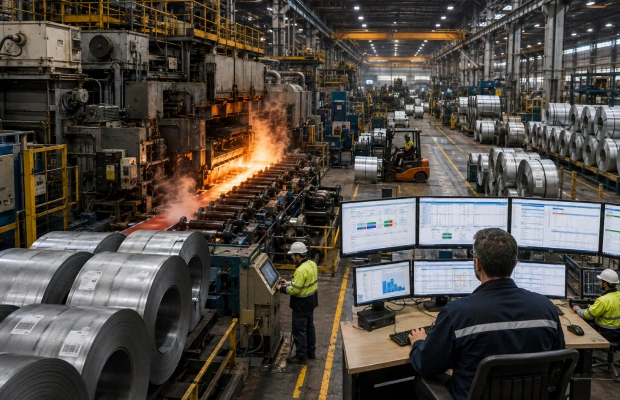
Steel is one of the heaviest and most complex industries to run. High supply and demand, massive production scale, huge inventories, and multi-stage processes — from sponge iron and pellet plants to steel melting shops and rolling mills — make steel manufacturing uniquely difficult to monitor and optimize. Manufacturers who want to stay competitive are turning to a cloud-based ERP solution for steel manufacturing that connects every stage of production through data.
This is where Lighthouse ERP for the steel industry comes in — bringing together IoT connectivity, business intelligence, and enterprise resource planning into one unified, cloud-based platform built specifically for steel plants.
What Is ERP Software, and Why Does the Steel Industry Need It?
Enterprise Resource Planning (ERP) software is a set of integrated tools that helps a company plan, manage, and monitor its resources — production, inventory, finance, sales, and more — from a single platform. For large, resource-heavy operations like steel plants, ERP software isn't optional; it's essential for staying in control without micromanaging every department.
Lighthouse ERP software for the steel industrygives manufacturers complete visibility and control over operations — automating processes that would otherwise require constant manual oversight, and freeing up management to focus on strategy instead of firefighting.
Add IoT integration to that ERP backbone, and steel plants gain something even more powerful: intelligently connected machines, sensors, and systems on the factory floor that feed real-time data straight into the ERP system — turning raw shop-floor signals into decisions the business can act on.
The Biggest Challenges Facing the Steel Manufacturing Industry
Steel manufacturers generate enormous volumes of data every day, but most of that data is trapped in disconnected systems. This is one of the biggest reasons productivity stalls across the industry.
When data lives in silos — one system for inventory, another for production, another for finance — the effects ripple through the entire business:
- Slower decision-making because managers lack a single, real-time view of operations
- More manual, paper-heavy processes that eat into staff time better spent on planning and forecasting
- Reduced business agility, since forecasting and budgeting become guesswork without accurate visibility
- Lower product quality and customer experience, as disconnected systems make it harder to catch and correct issues early
In short: disconnected data means disconnected operations — and in an industry as complex as steel manufacturing, that gap is expensive.
The Solution: Connectivity Through IoT-Enabled ERP
The single factor that ties every steel manufacturing department together — production, inventory, quality, sales, and finance — is connectivity. Industry 4.0 has made this connectivity far more achievable, giving manufacturers the tools to automate processes and capture real-time data straight from the production line.
ERP technology has already proven its value across steel plants by integrating existing systems with newer technologies. IoT is the natural next step — a network of interconnected devices, sensors, machines, and people that continuously generates operational data.
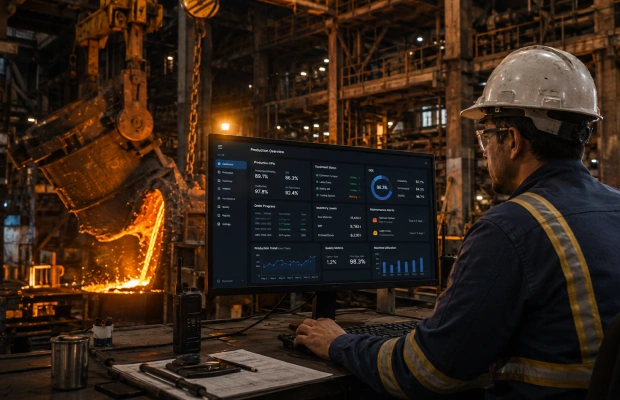
When IoT sensors are connected directly into a steel manufacturing ERP system, and paired with a business intelligence (BI) dashboard, plant managers get a live, consolidated view of the entire operation — enabling faster, data-driven decisions and better production planning.
7 Ways IoT-Integrated ERP Transforms Steel Manufacturing
1. Integrate
Steel production is a long, multi-stage process, which makes it difficult to track every activity end-to-end. ERP integration connects every system so status data flows automatically across the production cycle, while IoT sensors convert raw machine data into actionable information that helps manufacturers continuously improve their process.
2. Monitor
Steel plants produce thousands of product variants simultaneously to match supply and demand. A BI-powered ERP dashboard lets manufacturers monitor each product individually in real time — rather than relying on aggregate, delayed reporting — so issues are caught and corrected before they scale.
3. Consolidate
Even after adopting new technology, many steel manufacturers still struggle because their data lives in disconnected sources. A centralized cloud ERP platform consolidates data from every department — production, inventory, procurement, finance — into one system for accurate, in-depth analysis.
4. Optimize
Once data is consolidated, manufacturers can run deeper analysis, cut costs, and save time that would otherwise go into manually reconciling disconnected sources. A centralized, cloud-based BI dashboard puts every metric that matters within reach.
5. Automate
Manual data aggregation across complex industrial tasks is slow and error-prone. ERP automation, powered by BI tools, eliminates the need to retrain staff on new systems every time a technology upgrade rolls out — reducing both errors and delays.
6. Predict
Before predictive analytics tools existed, steel manufacturers routinely lost output to scrap — often caused by improper furnace temperatures, poor visibility into the production cycle, weak raw material planning, or overlooked chemical impacts. Lighthouse ERP's IoT platform helps manufacturers identify these risk factors early, enabling predictive maintenance and fewer costly defects.
7. Generate Smart Data
Steel plants already run on sensors — temperature sensors, belt rotation sensors, defect detection sensors, and more. The problem isn't a lack of data; it's a lack of usable data. IoT-enabled Lighthouse ERP for steel fabrication connects every sensor to a centralized platform, transforming raw sensor output into smart, structured data that operators and executives can actually act on.
Why Choose Lighthouse ERP for Steel Manufacturing
Lighthouse ERP is built specifically around the realities of running a steel plant — from PLC and DCS integration for seamless shop-floor data flow, to grade-wise and size-wise inventory tracking, to a unified system spanning sponge iron/DRI, pellet plants, steel melting shops, rolling mills, power plants, and coal washeries.
As one of India's leading cloud-based ERP solutions for the steel industry, Lighthouse ERP combines:
- Real-time IoT data capture from the shop floor
- A centralized BI dashboard for cross-department visibility
- Predictive analytics to reduce scrap and downtime
- End-to-end automation across production, inventory, and finance
For steel manufacturers looking to modernize, the message is clear: IoT and ERP integration isn't just a competitive advantage anymore — it's the standard for smart, connected steel manufacturing.