ERP for EXIM & International Trade Industry

ERP software for the EXIM & International Trade Industry

In the EXIM and International Trade industry, managing timely deliveries isn’t just operational, it's reputational. Delays at ports can lead to heavy demurrage charges, missed commitments, and a loss of trust with international clients. With intricate dependencies on multi-modal logistics, real-time inventory visibility, and port coordination, material handling becomes a critical control point in sustaining profitability and credibility.

Lighthouse ERP was designed particularly to meet the demanding requirements of international trade. Businesses can operate with confidence across borders, which handles everything like managing challenging Letters of Credit and Bank Guarantee transactions to ensuring real-time compliance with DGFT requirements, customs documents, and international health and safety protocols.

Backed by decades of domain expertise since 1987, Lighthouse ERP for EXIM and International Trade integrates all operational layers logistics, finance, documentation, compliance, and costing into a centralized system. With import-export management module, success lies in deep mapping of industry-specific workflows, offering exporters and importers a robust, accurate, and fully compliant solution tailored to the nuances of international trading operations.
ERP for EXIM & International Trade Industry
lighthouseindia
lighthouseindia

Challenges of EXIM Trading

Challenges Delivery Delays

Complex documentation & compliance

A large volume of customs, shipping, and regulatory documents increases the possibility for errors and delays.

Challenges Material Handling

Forex fluctuations and currency risk

Exchange rate changes impact costing, margins, and supplier payments.

Challenges Poor Trade Finance

Logistics unpredictability & delays

Delays in shipment, changes in ETA, demurrage, container tracking issues.

Challenges Compliance gap

Landed cost calculation complexity

The possibility of manual errors in freight, insurance, duty, and port charge calculations.

Challenges Inconsistent Policy Updates

Poor inventory visibility across locations

In-transit, bonded, under-customs, and free stock are not clearly visible.

Challenges Limited Port Visibility

LC/Payment instrument tracking challenges

LC amendments, validity, utilization, bank charges are difficult to monitor manually.

Challenges Port Operations

Pricing volatility & quotation risks

Commodity price fluctuations impact margins and quote accuracy.

Benefits of ERP for EXIM Trading

Benefit Ensure On-Time Shipments

Automated Document Control

The features of centralised document management, automated document generation, and HS code mapping will be used to prevent missed documents.

Benefit Streamlined Global Logistics

Forex & Multi-Currency Management

Real-time currency updates, rate locking, automated Forex impact on costing, multi-currency PO & invoicing.

Benefit Centralized LC/BG

Shipment Tracking & Cost Alerts

Each shipment tracking is integrated; alerts on ETA/ETD, recording of port and demurrage costs—better planning of stock arrival and commitments.

Benefit Built-in compliance

Landed Cost Automation

Automated calculation of landed cost with appropriate assignment of cost across items/lots.

Benefit Real-time trade policy

Real-Time Inventory Visibility

Real-time view of multi-location inventory with status tracking: in-transit, under clearance, and available.

Benefit Real-Time Container Tracking

LC / TT / BG Tracking

LC/ TT/ BG tracking against POs, Auto alerts on expiry, full utilisation visibility.

Benefit Real-Time Container Tracking

Smart Pricing & Margin Control

Dynamic pricing rules, quote validity alerts, historical cost analytics, and margin protection logic.

Features of Lighthouse ERP for EXIM International Trade Industry

icon

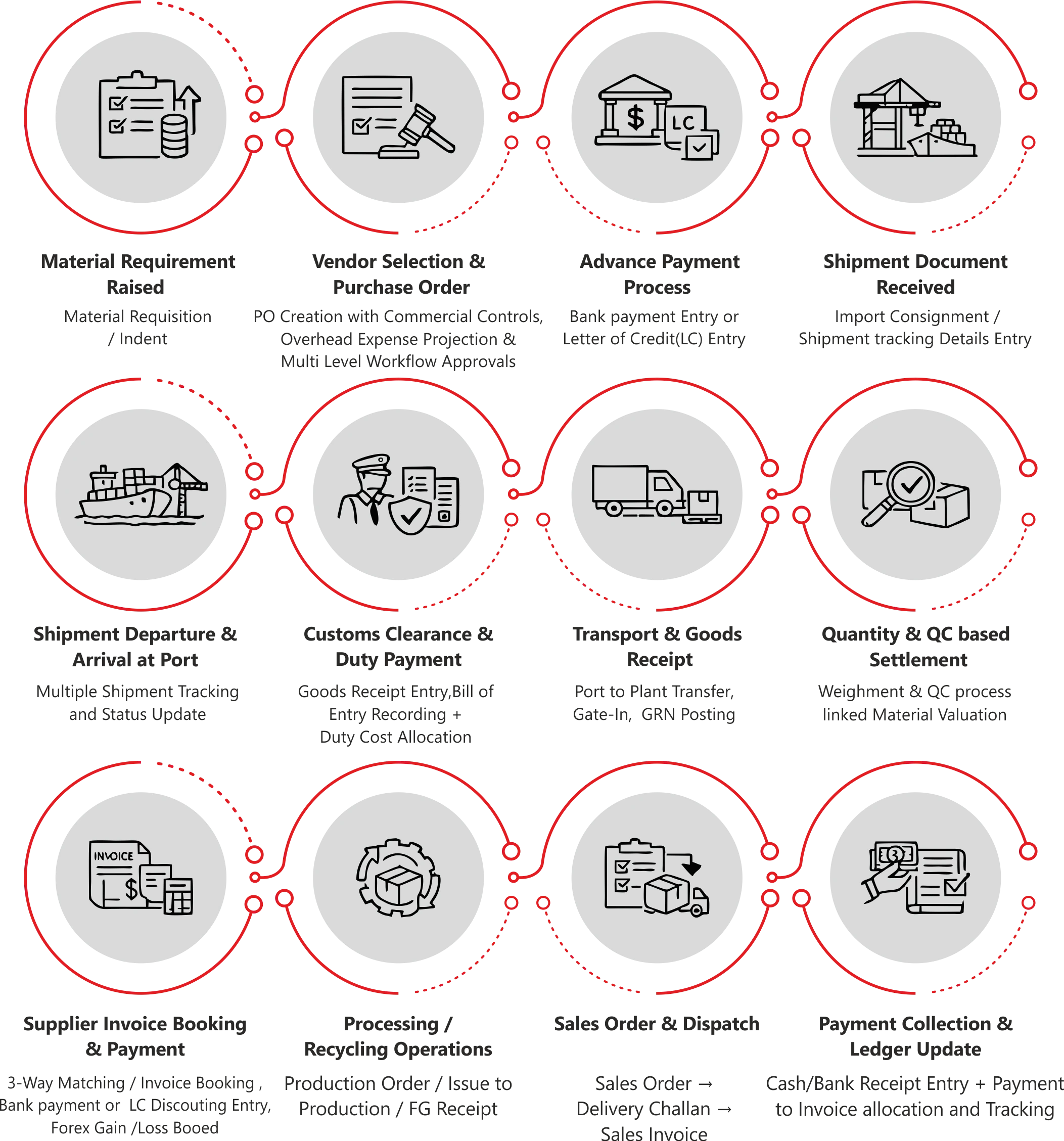
Letter of Credit (LC) & Forex Management

Manage Letters of Credit, Bank Guarantees, and foreign exchange contracts with complete visibility and control over fund flow and payment terms.

icon

Consignment Delivery Scheduling

Track and manage shipment timelines with real-time delivery schedules to avoid delays, demurrage charges, and port penalties.

icon

Export Incentive & License Tracking

Monitor DEPB, DFRC, DEEC, DRBK, and other advance licenses, including duty drawback claims linked to export invoices.

icon

Export & Import Documentation Automation

Generate standard formats for export/import documents such as Shipping Bills, Invoices, Packing Lists, Certificates of Origin, Bills of Entry, and e-Invoicing.

icon

Landed Cost Calculation

Accurately allocate all associated costs freight, duties, taxes, insurance, and hidden charges to determine true landed cost per item or consignment.

icon

Profitability Analysis per Consignment

Link sales and purchase transactions to calculate profit or loss on each consignment, including export-related expenses and overheads.

icon

Tax Compliance & Statutory Reporting

Ensure compliance with customs duties, GST, and EXIM regulations through built-in tax engines and automated statutory reporting.

icon

Quality Inspection of Consignments

Conduct quality checks at the point of material receipt or dispatch to meet international health, safety, and product standards.

icon

Logistics & Port Stock Management

Manage material movement, transit inventory, and port stock handling with end-to-end visibility across logistics networks.

icon

Commission & Brokerage Tracking

Automate calculation and disbursement of agent commissions and brokerage fees based on trade agreements and export contracts.

Frequently Asked Questions About ERP for EXIM & International Trade Industry

It's an ERP built for exporters and importers managing cross-border trade — covering Letter of Credit and Bank Guarantee management, multi-currency transactions, customs documentation, landed cost calculation, export incentive tracking, port stock management, and GST and DGFT compliance — all within one system. In international trade, where a documentation error or a missed LC deadline can hold an entire shipment, having these functions integrated rather than handled across separate tools is not optional.

The full LC lifecycle — issuance, amendments, utilisation, expiry alerts, and bank charges — is tracked within the system. Foreign exchange contracts are managed alongside this, with real-time currency updates applied to purchase and sales valuations so that the Forex impact on cost and margin is always reflected in current figures rather than calculated retrospectively at month end.

Landed cost is the total cost of bringing an imported item to its destination — purchase price plus freight, insurance, customs duty, port handling, and any other charges. ERP calculates this automatically and allocates it across items or lots in the consignment, so the true cost per unit is known before the goods are sold. Inaccurate landed cost calculation is one of the most common sources of margin erosion in import trading.

Export incentive licences — DEPB (Duty Entitlement Passbook), DFRC, DEEC, DRBK, and advance licences — are tracked within the system and linked to the export invoices they relate to. This linkage ensures that drawback claims are raised against the correct shipments and that licence utilisation is monitored against available balance, reducing the risk of over-utilisation or missed claims.

Standard export and import documents — Shipping Bills, commercial invoices, packing lists, Certificates of Origin, Bills of Entry, and e-invoices — are generated from the trade data already in the system rather than typed up manually. This reduces the documentation errors that cause customs delays and allows the same set of transaction data to produce multiple required documents in the correct format for each authority.

Stock status is tracked across multiple states — in-transit, under customs clearance, bonded, and available — so the team knows exactly what is accessible at any given moment and what is still tied up in the clearance process. For importers managing multiple simultaneous shipments, this real-time inventory status is what makes reliable delivery commitments to customers possible.

Sales and purchase transactions for each consignment are linked, and all associated costs — freight, duties, insurance, agent commissions, brokerage — are allocated to that consignment. The result is a profit or loss figure at the individual shipment level, which is far more actionable than a blended company-wide margin that hides which trade flows are generating returns and which are not.